Fargher Trout
I first met Stew years ago, after a hike that had lasted a few days longer than planned. I am one of the few outdoorsmen who can claim to this day that he has never been lost. I usually make this claim to expressions I'm convinced are admiration, and there have been some who actually exhale rapidly in awe and quickly look away to show their humility. It is something I don't take excessive pride in. We're all given certain talents.
On this occasion, I must admit that while at no point was I lost, I had become confused for a couple of days. It was on the evening of the third day, that I had logically worked out the path home through what can only be regarded as an exemplary application of logic and the scientific method. Over the preceding two and a half days, I had carefully worked out a variety of paths which were not the way home, leaving only one path remaining. Logically, this had to be the correct one, and I confidently set out down that path.
When at last I saw lights up ahead on the trail, I realized that the times were progressing amazingly. While a few years ago, it took four to six months to build a house, here was a new house I had never seen before, having apparently been built completely from raw forest to finished house in the three days I had been gone. This kind of progress always fills me with admiration, and I walked across the lush green lawn, past a few stripped pickups the owner had apparently quickly hauled in and surrounded with fifty foot cottonwoods, and up to the door to welcome the new owner to the area and perhaps ask for a ride to the main highway.
When the door opened, the smell of cooking hit me in the face like a dog tongue at a picnic. The man who answered the door was clad in a pair of Red Wing workboots, a bathing suit in the design of an English flag, and a fishing vest. He introduced himself as Stew Fargher, and said he was a cook for the local logging camp. After initial introductions, he asked me if I was hungry, perhaps on account of the large puddle of drool puddling at my feet. I indicated that I generally didn't like to eat before Saturday, but was feeling a bit peckish and would sit down and have some dinner if he was going to eat anyway.
I told him I'd never had a meal prepared by a professional cook before, and asked him what kinds of things he cooked at the logging camp. He said he had one specialty, that he'd been named for, but after all these years, I can't remember what that was. "Tonight", he told me, "we're having trout!" Now, I'd been eating trout since I was old enough to spit the bones, and it's a dish I have never tired of. The trout that Stew served up that night were truly something special, though. I don't know if it was my three-day hike, or the fact that he was a professional cook, but those trout tasted like nothing I'd ever eaten before. I asked him what sort of trout these were, more to make conversation than from any real interest. I have never been able to tell a German Brown from a Rainbow by taste, which has caused me no small amount of ribbing among my chums. Stew informed me that this was a new, undiscovered type of trout, and that he was in high hopes of having it named for him. Of course, I had never met anybody who had discovered a new type of trout before, and you can rest assured that I was quite impressed. I asked him if he were some sort of scientist, and he admitted that he was taking some correspondence classes in marine biology from the South Dakota School of Mines, which he claimed had a vastly underrated marine biology department. Having established that I was in the presence of a scientist and a scholar, as well as a remarkable builder, I resolved to keep in touch with this undiscovered genius, in the hopes of learning more about carpentry, trout and cooking.
I believe it was several weeks later that Stew and I met again. I had just been gone for four days, chokecherry picking. To be honest, it was only supposed to be an afternoon jaunt to find a chokecherry tree that an old lady at the grocery store had given me directions to, having just come from there herself. After I helped her load her aluminum walker into her car, I proceeded toward the site she had carefully directed me to. She was apparently quite a hiker, and the deeper and deeper I pushed into the brush and trees, the more my regard for her as an outdoorswoman grew. To this day, I find myself marveling that she had visited this chokecherry tree in the course of a few hours, while I did not reach it even after hiking for four days. That's the kind of women we have in these parts, I'm proud to say. Anyway, Stew and I had arranged to meet at the local store, so I cut my chokecherry hunt short in order to make our appointment. After making me swear on my honor not to divulge the location he would take me to, he had agreed to guide me to a lake that contained his new discovery, which he had taken to calling Fargher Trout.
I am sworn to secrecy as to the location he took me to, as I have already explained. While it's been several years, and many people have interviewed him for newspaper articles and important national shows like David Letterman, he is still having trouble getting official notice that his discovery has been named for him and placed in the marine biology textbooks, which we both agree is the least they should do.
At the end of a set of wagon ruts we had followed for several miles from the nearest road, Stew parked by a small pond, with cattails growing out of the middle of it. "How far to the lake?" I asked, as I jumped out and began hauling my backpack out of the back, getting ready for the next leg of our journey. Stew told me that we were at the lake already, so I really didn't need to wear the backpack if I didn't want to. I told Stew that this was certainly not a full-grown lake, that it was still a pond, and asked if he intended that we camp here till it had grown up. Stew gave me his best marine biologist sneer, and informed me that this was most certainly a lake, and that anybody who hadn't taken two semesters of marine biology from a prestigious university weren't qualified to tell a lake from a pond. Thus humbled, I shrugged off my backpack and started gathering wood to get a fire going.
The next morning, Stew was in a better mood, as I had spent the evening complementing his cooking. I myself had gotten very little sleep, as the lake had a very sizeable bullfrog population, which bellowed loudly throughout the night. As I staggered out of my sleeping bag at 5:AM, he told me that Fargher Trout were extremely intelligent and very hard to catch on any tackle he had yet tried. The few specimens he had obtained so far, he had eventually just given up and netted them from the lake with a large four-foot net. I assured him that if there was one thing I was as gifted at as woodland navigation, it was trout fishing, and that we would find the tackle to tempt these new fish of his or know the reason why. Confidently I threaded up my old standby, a Panther Martin lure, and began to fish.
The Panther Martin was quickly discarded due to the large amounts of weeds and waterplants that it kept snagging with every cast. I thought to make a comment on the pond-like nature of this lake, but had learned my lesson the day before, and kept my opinion to myself. For the next seven hours, until noon, I tried everything in my tacklebox, from maggots to scorpions to flies to worms. Stew was also patiently trying permutations of baits and lures to tempt these difficult fish, but was having no success either.
At noon, we stopped to regroup and have some lunch. Stew stopped me when I went down to the lake to get some water for the coffee, telling me he thought the water might be radioactive. Mindful to keep a respectful tone, I asked Stew if he had a Geiger counter or other means to measure radiation. He told me that he didn't, but a few of the larger Fargher Trout he had netted in the past had had what almost looked like small legs growing from below their gills. Obviously mutant Fargher Trout. "Mutants", he told me, "are usually a result of high doses of radioactivity. Since these fish all live in this shallow lake here, and there are no streams feeding the lake or exiting from it, the radioactivity must be in the lake itself." I couldn't argue with his logic, and we made due with soda pop for lunch that day, as I certainly didn't want to turn into a mutant myself.
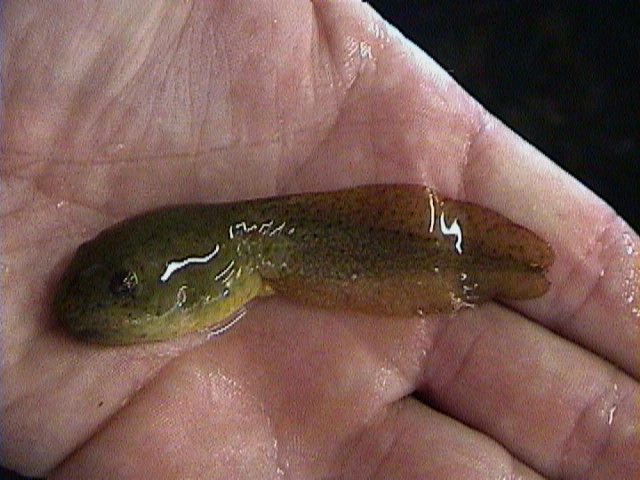
By five that afternoon, it became clear that the Fargher Trout weren't biting that day. Stew got out his net, and we netted some of the little beasties for dinner and to take photographs to send to the marine biology department in South Dakota. As fishermen, it was a big disappointment to resort to using the net, but science must progress, even at the expense of sport, and we both realized that. This was my first opportunity to actually see a Fargher Trout before Stew had prepared it for consumption. They were definitely a new species. They were about the same size as brookies, perhaps a little bigger. Their bodies were much rounder and shorter than a typical trout, and their tails were about as long as their bodies. Of those we caught that evening, some had one and sometimes two small sets of legs, and we discarded these mutants in the brush above the lake so they wouldn't pass their deformities to the next generation.
Stew and I have made several trips to the lake to fish for Fargher Trout. We have actually caught a few using fishing poles, usually by hooking their tales as we drag unbaited treblehooks across the bottom of the lake. In the winter the lake is frozen solid. In late fall and early spring, even with the net, no Fargher Trout can be found. It's like they just vanish during these times of year. Stew is writing a paper in which he postulates that the Fargher Trout migrate out of the lake, and head south for the winter, returning in late spring to swim the lake and lay their eggs. I asked him how they leave the lake, seeing as how there are no streams entering or exiting it. He assured me that to a marine biologist, this is not that mysterious. He's sending this paper to the journal "Science", but he's becoming more and more convinced that the established scientists are threatened by his discoveries and are hushing up his work.
It's almost summer again, and we'll go back out to the lake to fish for Fargher Trout, armed with new tackle and ideas on how to entice them to strike. I know we'll catch them this time.
-- End --
THC
Vancouver
June 2002